Buy high-speed PLA when your useful prints are limited by material flow and a supported profile can turn that extra flow into shorter jobs. Keep ordinary PLA when it already meets your quality and schedule needs. A high-speed label does not make every printer, miniature, or overhang run faster.
Research checked October 9, 2026. This is a buying framework based on manufacturer documentation, not a hands-on test. Example budgets are hypothetical US-dollar calculations, not current offers.
The question is whether a different roll removes a bottleneck you actually have. Start with a small trial quantity and one representative project; do not replace your whole material collection on the strength of an advertised movement speed. Check the selected listing’s minimum order quantity before assuming one roll can be purchased separately.
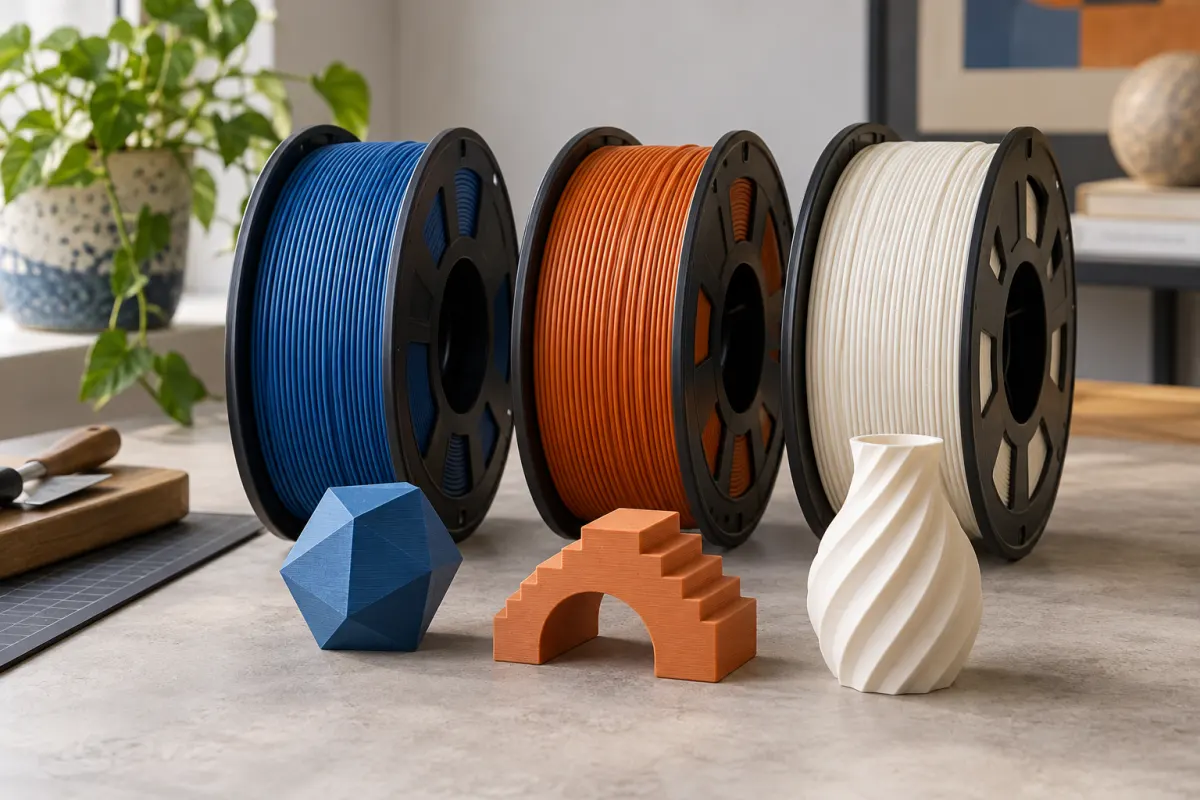
Separate material names from performance promises
| Choice | Reason to investigate it | Check before ordering |
|---|---|---|
| Standard PLA | Your current profile already produces satisfactory parts | Delivered price, color, and exact material guidance |
| SUNLU High Speed PLA | A separately sold high-speed formulation for a flow-limited project | Exact SKU and a supported printer/nozzle profile |
| SUNLU High Speed PLA+ | A named PLA+ variant within the high-speed range | Do not substitute ordinary PLA+ settings automatically |
| SUNLU High Speed PLA+ 2.0 | Another distinct high-speed product, rather than merely a new label on all PLA | Check the complete name on both listing and spool |
SUNLU lists each of these high-speed products in a 1.75 mm, 1 kg format and advertises speeds up to 600 mm/s. Those are manufacturer claims under suitable conditions, not our measured results or an instruction to set every print move to 600. No claim here establishes equal finish or mechanical performance between grades.
Look for a flow limit in the sliced job
Prusa explains maximum volumetric speed as a limit on how much material the hotend can process. The active constraint can be the material, the hotend, cooling, or a feature-specific speed setting. Higher material capability cannot remove every other limit.
Inspect your slicer's speed and flow previews for a model you actually print. Large, long extrusion paths give you a more useful investigation than a tiny decorative feature that repeatedly accelerates, turns, and slows. Keep the selected nozzle and layer height unchanged for the first comparison.
Do not confuse a movement-speed field with the completed-job estimate. If changing a supported material preset barely changes the estimated completion time, there is little time-saving case for that purchase. A different color or finish could still justify it, but that is a separate reason.
Estimate flow demand, then compare job time
For an intentionally simplified example, multiply line width × layer height × movement speed. A 0.45 mm line at 0.20 mm layer height and 150 mm/s is approximately 13.5 mm³/s; at 250 mm/s it is approximately 22.5 mm³/s. This rectangular approximation illustrates the scale of demand; the slicer's extrusion model and preview are more precise.
Imagine your current supported setup handles the first case well but not the second. A higher-flow roll is a candidate only if the hotend and the rest of the profile also support the second case. Buying it does not prove they do.
Now suppose a 250 g organizer takes six hours on the established profile and five on a validated alternative. That hypothetical result saves one hour, or about 17% of the original job time. It does not save 40% merely because one speed setting changed from 150 to 250.
Price the benefit per completed project
At hypothetical delivered prices of $18 and $24 per kilogram, a 250 g job uses $4.50 or $6.00 of material: a $1.50 premium. If the shorter job frees the printer for another planned job, that premium may be reasonable. If both jobs finish comfortably overnight, the same saving may have little practical value.
Include supports, purge, and trial material. Two 30 g comparison pieces consume 60 g; record that as part of learning the new roll rather than hiding it in a claimed saving. Keep electricity and hands-on time separate unless you have measured them.
A sale can also make the higher-speed option cheaper. Compare equal net masses and delivered carts, then choose on actual suitability. The PLA buying guide covers the basic purchasing checks. SUNLU is one available supplier of the verified variants above.
This link opens SUNLU’s store. Select the exact model, material, package, and shipping region described above.
We may earn a commission if you buy through links marked “paid link.” How our links work.
Browse the SUNLU store (paid link)Make the first spool a controlled trial
- Record the existing material, nozzle, plate, and successful profile.
- Choose a model with the wall finish, overhangs, and assembly features you care about.
- Use the selected filament's current guidance within the printer's limits.
- Change one meaningful setting at a time and save each profile separately.
- Compare completed dimensions, visible defects, layer bonding, and actual elapsed time.
- Reprint a useful part before buying a multipack.
Follow the exact spool and dryer instructions for preparation. Do not raise heat beyond supported limits to chase a headline speed. SUNLU's High Speed PLA listing currently contains differing bed-temperature guidance in separate sections, so resolve that against the supplied documentation and your build surface instead of guessing.
A practical buy-or-skip decision
Buy a trial roll if long extrusion paths occupy much of your workload, your hardware has usable flow capacity, and reducing elapsed time solves a real scheduling problem. Keep standard PLA if you mostly print small detailed pieces, value an already reliable preset, or have no pressing throughput need.
A high-speed PLA remains a particular PLA formulation. Prusament lists heat resistance as a limitation of ordinary PLA; a speed-oriented name alone supplies no evidence that a different roll suits a hot environment. Review the actual material data for the application.
Our comparison has no measured speed winner. The useful outcome is a repeatable, acceptable part at a known cost. For the similarly named SUNLU plus products, continue with PLA+ versus PLA+ 2.0 before ordering.
Sources & further reading
- SUNLU: High Speed PLA 1 kg product and settings
- SUNLU: High Speed PLA+ 1 kg product
- SUNLU: High Speed PLA+ 2.0 1 kg product
- Prusa: maximum volumetric speed
- Prusament: PLA properties and limitations
Manufacturer guidance can change. Check the instructions for your exact printer, build surface, and filament.