Choose SUNLU PLA+ 2.0 as a small trial when its exact color, availability, price, or supported profile suits your next project. Do not replace a working PLA+ roll simply because “2.0” sounds universally stronger. The checked standard product pages contain overlapping specifications, so they do not support a clean numerical performance ranking.
Research checked October 9, 2026. This is a buying framework based on manufacturer documentation, not a hands-on test. Example budgets are hypothetical US-dollar calculations, not current offers.
This article compares the regular PLA+ and regular PLA+ 2.0 names first. SUNLU also sells High Speed versions; those are separate purchasing choices and must not be silently mixed into the comparison.
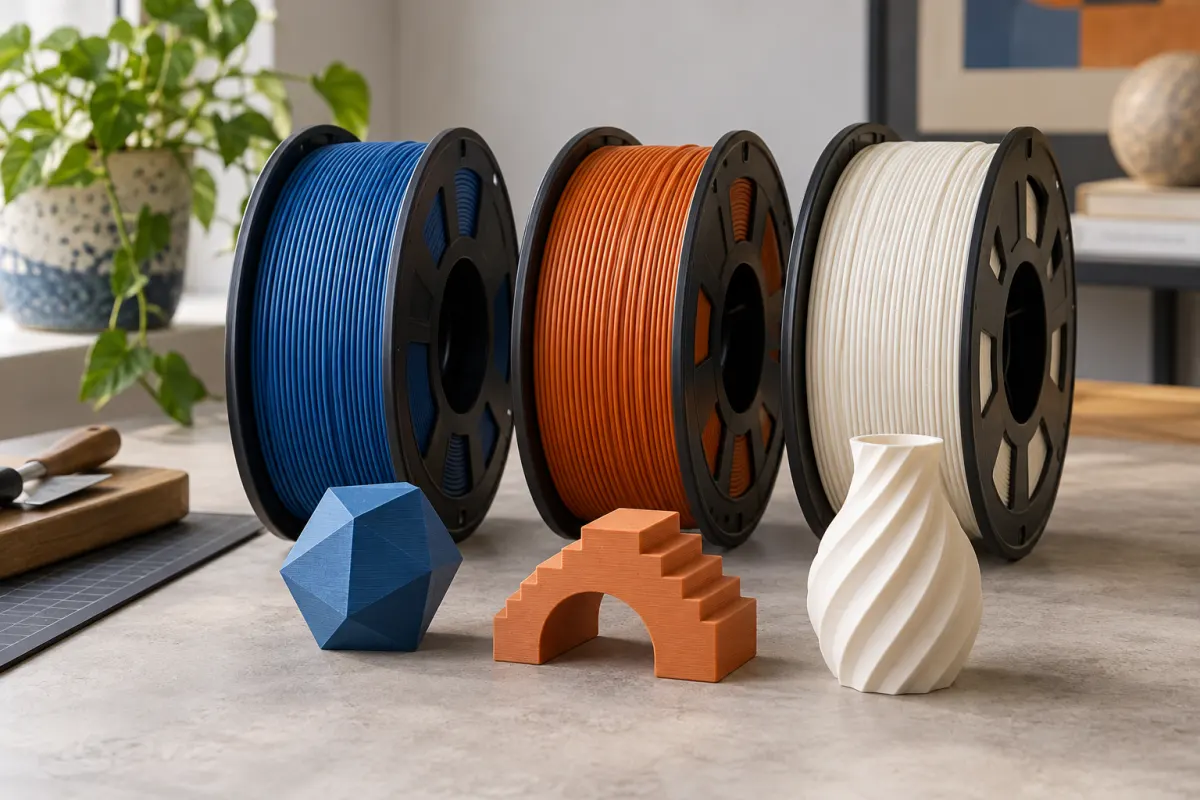
Identify which of the four names is in your cart
| Product | What the name identifies | Buyer action |
|---|---|---|
| PLA+ | The regular PLA Plus listing | Keep its own documentation with the roll |
| PLA+ 2.0 | The regular revised Plus listing | Compare its actual variant, not an old review title |
| High Speed PLA+ | A separate high-speed Plus listing | Check the full name in a slicer preset |
| High Speed PLA+ 2.0 | A separate high-speed revised Plus listing | Do not infer its settings from regular 2.0 |
All four checked listings describe 1.75 mm material in 1 kg rolls. That common format does not make the formulations interchangeable. Refills, regional bundles, and other spool sizes need separate checks even when the material name matches.
Save a screenshot or order description containing the selected material and color. A receipt saying only “PLA filament” will not help you reproduce a successful result several months later.
What the published data does—and does not—establish
During our check, both regular product pages listed the same table values for tensile strength, flexural modulus, and notched impact strength, while their promotional descriptions used different comparative language. The PLA+ page also contained differing speed ranges between sections. Those inconsistencies are a reason to ask for the current technical data for your SKU.
We therefore do not state that 2.0 is a particular multiple stronger than regular PLA+. A valid numerical comparison needs the same test standard, sample preparation, orientation, and conditioning, as well as clearly identified formulations. A shared number in a storefront table does not prove the materials are identical either.
The defensible distinction is that SUNLU sells them as separate named products. Treat advertised improvements as a reason to investigate, then judge whether the documentation answers your intended use. For the broad terminology, read what PLA+ means across brands.
Choose the property your project needs
Write a requirement such as “this desk tray must fit the drawer” or “this noncritical clip must survive my intended flexing motion.” Those statements separate appearance, stiffness, impact behavior, and repeat bending. The single word “strong” does not.
A visual mockup may need color and clean surfaces more than toughness. A mating part needs repeatable dimensions with your own profile. A part exposed to heat needs appropriate material data; a plus suffix does not answer that question. Prusament’s PLA documentation describes ordinary PLA’s temperature limitations, illustrating why a formulation name should not substitute for application checks.
If your existing SUNLU PLA+ already satisfies a modest indoor project, continuing with the same known variant is reasonable. Investigate 2.0 when it offers a benefit you can name, or when you want to compare a small sample before your next large batch.
Work out how much the trial really costs
Suppose regular PLA+ costs a hypothetical $16 delivered per kilogram and regular PLA+ 2.0 costs $19. A 150 g organizer would consume $2.40 versus $2.85, a difference of $0.45. Two 25 g test pieces, one from each roll, would use $0.40 and about $0.48 of material respectively.
The trial's material premium is small in that example, but buying two full rolls ties up $35 rather than $16. If you will not use both, a sample or a single new roll after finishing the current one may be the better budget choice.
Do not use those numbers as current SUNLU prices. Compare the same shipping region, net mass, quantity requirement, and spool format in your actual cart. Our bulk and refill guide explains why a low per-roll headline may conceal a larger initial purchase.
Compare finished parts without creating a fake laboratory test
Print a familiar small model first, then a representative section of the real project. Keep the geometry, orientation, nozzle, and plate consistent while using appropriate settings for each material. Label each sample so appearance does not become your only memory of which roll produced it.
Record practical observations: whether it assembles, whether support cleanup is acceptable, and whether it survives the intended noncritical use. Do not turn a hand bend or one accidental drop into a universal strength claim. That would say little about another geometry or print direction.
If speed is your actual objective, investigate flow limits and high-speed PLA before changing families. Prusa’s volumetric-speed guidance makes clear that material and hotend capability both matter. A newer number on the box does not measure your completed-job time.
Before you place the order
- Match regular or High Speed, Plus or Plus 2.0, on every label.
- Check diameter, net weight, spool or refill, and automatic-feeder fit.
- Download the current product guidance and resolve conflicting settings with the supplier.
- Choose a modest first quantity in a color you can use.
- Compare delivered price and keep the successful material profile.
SUNLU's store offers the verified product families in this guide. Use the complete product name when searching it; the store link does not preselect a grade or confirm a particular warehouse has stock.
This link opens SUNLU’s store. Select the exact model, material, package, and shipping region described above.
We may earn a commission if you buy through links marked “paid link.” How our links work.
Browse the SUNLU store (paid link)Buy the version that best fits the documented requirements and your trial result. We have not tested these rolls, and the present public data does not justify naming an overall mechanical winner.
Sources & further reading
- SUNLU: PLA+ 1 kg specifications
- SUNLU: PLA+ 2.0 1 kg specifications
- SUNLU: High Speed PLA+ 1 kg product
- SUNLU: High Speed PLA+ 2.0 1 kg product
- Prusament: PLA properties and limitations
- Prusa: maximum volumetric speed
Manufacturer guidance can change. Check the instructions for your exact printer, build surface, and filament.