Keep a compatible brass nozzle for ordinary unfilled filament when the filament maker allows it; choose a supported abrasion-resistant nozzle when the exact filament requires one. For a V6-compatible hotend, E3D V6 Brass and V6 Hardened Steel offer a meaningful material comparison at the same diameter.
Confirm the hotend interface before choosing either. “0.4 mm” describes the outlet, not the mounting system. This buying guide uses manufacturer specifications rather than our own wear tests, and treats nozzle material, geometry, and flow capability as separate decisions.
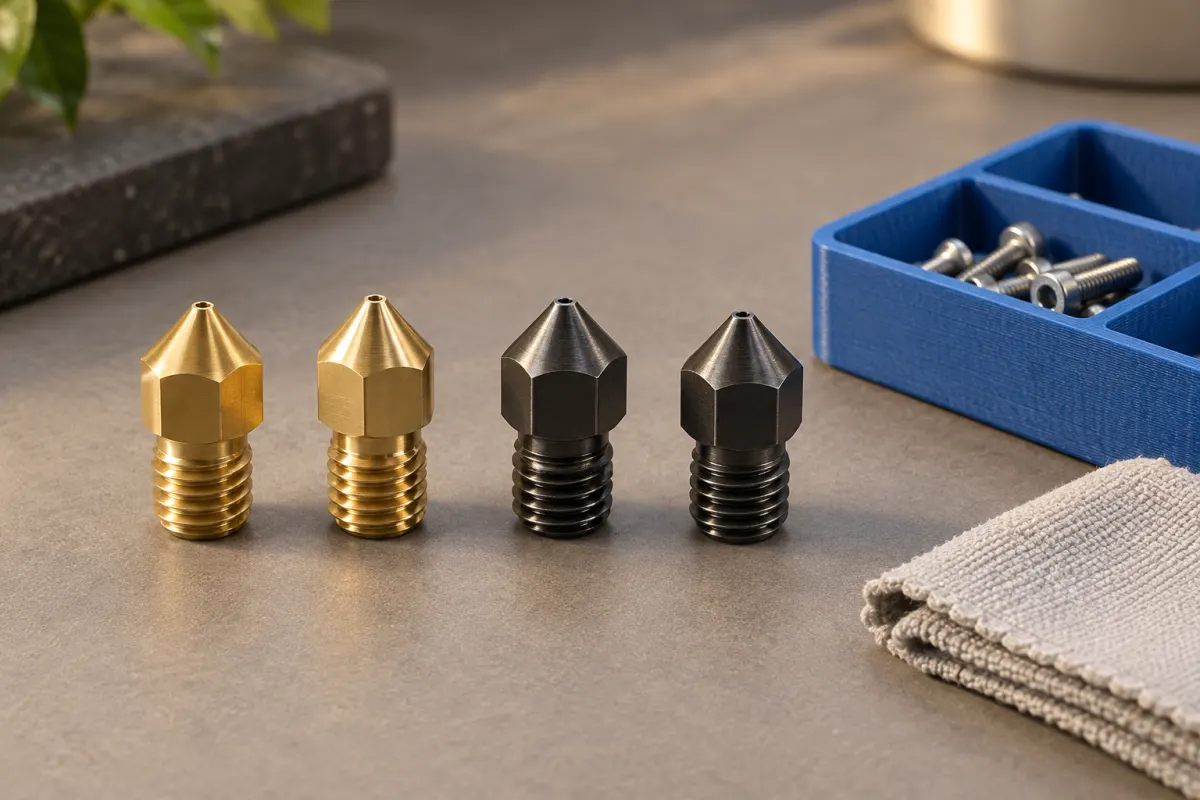
Compare material within one nozzle family
| Option | Manufacturer’s abrasion classification | Suitable buying question |
|---|---|---|
| V6 Brass | Not abrasion resistant | Does my unfilled filament permit brass? |
| V6 Hardened Steel | Abrasion resistant | Does my abrasive filament require this type of nozzle? |
| V6 Stainless Steel | Not abrasion resistant | Do I have a specific reason to choose stainless? |
E3D’s V6 reference lists compatible hotends, filament-diameter variants, and separate material ratings. Stainless steel and hardened steel are different options; the word “steel” alone does not establish abrasion resistance.
Do not treat a nozzle's maximum temperature rating as permission to run the printer at that temperature. The complete hotend, heater, sensor, firmware, and printer limits still apply. A change of nozzle material is also not a promise of stronger finished parts.
Let the exact filament decide whether wear resistance matters
Read the requirements for the specific filled filament you plan to use. Carbon fiber, glass fiber, and other additives can change nozzle requirements, but the large material name on the spool is not a complete specification. The recommended opening may matter alongside nozzle material.
For example, Bambu Lab’s PETG-CF page recommends hardened steel nozzles in listed diameters and does not recommend stainless steel for that product. That is a product-specific requirement, not proof that every spool labeled PETG needs an upgrade.
If you mainly print ordinary PLA organizers and your current brass nozzle is producing consistent results, wear resistance alone may offer little immediate benefit. Buy for an identified material requirement or a diagnosed replacement need, rather than assuming the harder nozzle is universally better.
Check more than the thread
- Identify the installed hotend. Record the actual assembly, including any prior upgrade.
- Match the nozzle family. Use the manufacturer's explicit compatibility list.
- Match filament diameter. Nozzles for different feed diameters are separate variants.
- Check the complete geometry. Thread, sealing arrangement, length, and heater interface must match.
- Check installation and profiles. Confirm that the supported replacement procedure and slicer setup cover the chosen part.
A similar-looking threaded nozzle is not enough. Do not infer interchangeability from a nominal thread or wrench size. An incorrect length or mating interface can create a problem even when the part appears to screw into place.
An integrated nozzle is a different purchase
The Prusa Nozzle Brass CHT 0.4 mm combines its nozzle with an integrated filament guide for specified Nextruder printers, including the MK4S. It is not simply an E3D V6 brass nozzle with another label. The product also distinguishes its compatible models from newer nozzle generations.
For a hypothetical MK4S owner replacing that exact nozzle, buying a bare V6 part because both say “brass 0.4” would miss the interface requirement. An adapter route, where explicitly supported, is a separate configuration that must be purchased and installed as such.
This also shows why brass versus steel is not a complete speed comparison. The CHT designation describes a different internal design. Do not compare a high-flow brass assembly with a conventional steel nozzle and attribute every difference to the metal.
Plan the profile change before placing the order
Find the manufacturer's supported profile for the installed nozzle size and type. Prusa’s nozzle-profile guidance explains that nozzle changes affect more than a single label in the slicer. Save the working project and profile before modifying the setup.
Do not add a fixed number of degrees simply because a nozzle is hardened steel. Use the supported starting point and the exact filament guidance, then investigate any problem through a controlled comparison. Increasing speed, temperature, and flow together makes a poor result harder to diagnose.
For an otherwise equivalent replacement, start with a familiar short print and inspect extrusion continuity and dimensions. If you also change diameter, compare slicing and detail separately using our 0.4 versus 0.6 mm guide. A larger opening does not guarantee the hotend can melt material at the requested rate.
Buy the smallest change that meets the requirement
Buy compatible brass for a straightforward replacement when your filament permits it. Buy compatible hardened steel or another specifically approved wear-resistant option when the material requires it. Delay the purchase when the only evidence is an unexplained printing defect.
A tangled spool, restricted feed path, wrong profile, or partial obstruction can resemble nozzle wear. Our under-extrusion workflow helps check the path before spending money or increasing flow.
Current delivered prices and stock are unverified. Compare the complete supported installation, including any required adapter, tools, or assembly components. Keep one labeled baseline replacement if downtime matters, and store its exact part number with the printer record.
Sources & further reading
- E3D: V6 nozzle compatibility and material specifications
- Bambu Lab: PETG-CF nozzle requirements
- Prusa: Brass CHT 0.4 mm Prusa Nozzle
- Prusa: creating profiles for different nozzles
Manufacturer guidance can change. Check the instructions for your exact printer, build surface, and filament.