Consider carbon-fiber PLA for a specific finish or documented stiffness requirement after checking the entire printer's abrasive-material compatibility. Budget for a suitable nozzle and any other required hardware. Choose plain PLA when you only need a simple prototype and cannot name a benefit from the filler.
Research checked October 9, 2026. This is a buying framework based on manufacturer documentation, not a hands-on test. Example budgets are hypothetical US-dollar calculations, not current offers.
PLA-CF is a PLA-based composite, not a replacement for continuous carbon-fiber laminate or a promise that every printed part will be stronger. This guide helps you decide whether a trial spool has a useful job in your workshop.
Check the selected seller’s minimum cart quantity as well as the weight of each spool. A listing describing 1 kg rolls can still require a multipack; choose a seller offering a suitable trial quantity before committing to unfamiliar material.
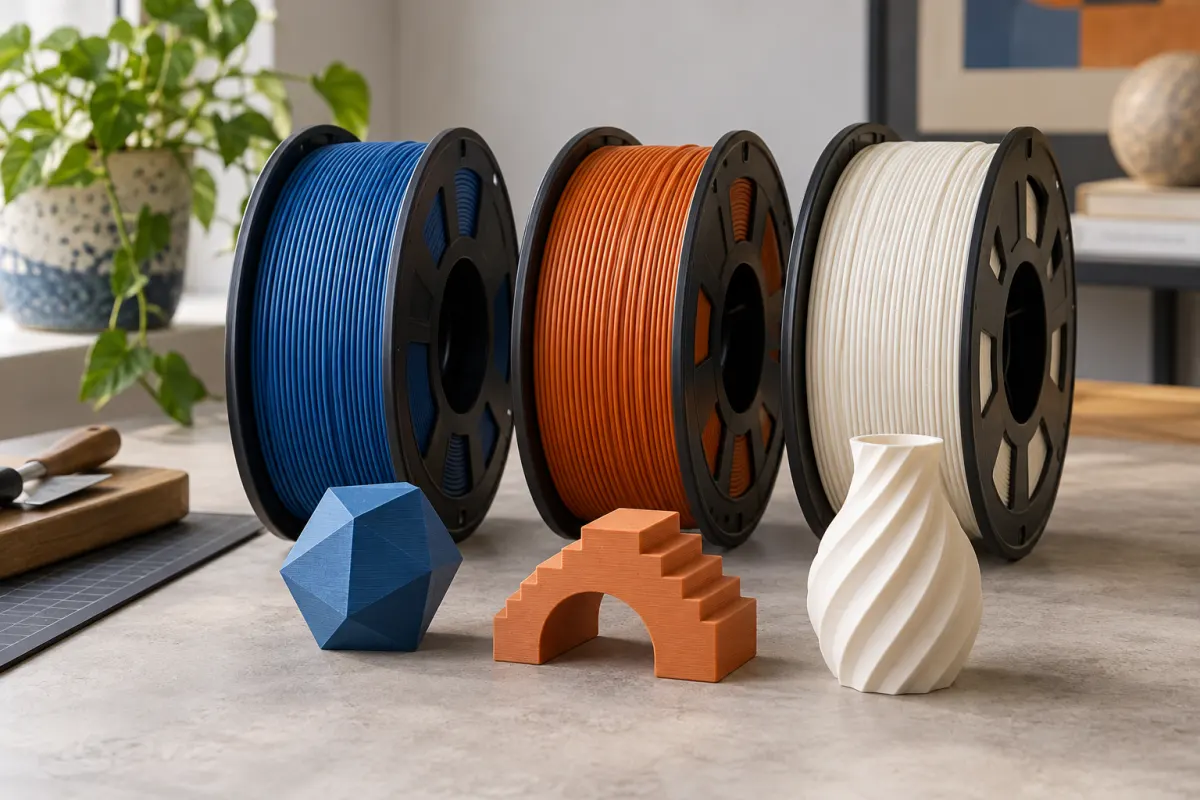
Separate the polymer, the filler, and the finished part
| Requirement | What to investigate | What the label cannot prove |
|---|---|---|
| Textured or matte appearance | An exact product sample and the visible surfaces of your model | That every color and profile produces the same finish |
| Stiffness | Relevant technical data with its test method and direction | Universal resistance to impact or repeated flexing |
| Higher temperature use | The actual composite temperature data and loading conditions | That adding carbon fiber removes PLA limitations |
| Low-cost size prototype | Whether ordinary PLA already meets the brief | That a premium spool improves a simple fit check |
SUNLU sells a PLA-CF product described as containing 15% carbon fiber. Its page lists a heat-deflection temperature of 53°C. Treat that as a product data point with test conditions to verify, not a universal operating-temperature rating for your printed object.
Check abrasion resistance before opening the roll
Prusa identifies carbon, glass, and Kevlar fillers as abrasive and calls for a hardened nozzle. Confirm an approved nozzle for your exact hotend, not simply a matching thread that happens to screw in. Installation, heat transfer, length, and sensor arrangements can matter.
Check the extruder and automatic feeder documentation too. A nozzle upgrade does not certify every gear, tube, inlet, or feeder path for that filament. If the maker requires an external spool path, plan a supported arrangement instead of forcing the material through an unsupported unit.
Prusa’s Nextruder nozzle guide distinguishes abrasion-resistant designs from ordinary options. That is an example of the model-specific documentation to seek; it is not a recommendation to fit a Nextruder component to a different printer. Add the approved hardware, tools, and replacement parts to your shopping list before comparing spool prices.
A wider nozzle can change the project
Read the filament maker's minimum nozzle recommendation and the printer's supported profiles. Fillers can increase clogging risk, and a tiny detail nozzle may be a poor match. Do not infer that every PLA-CF formulation uses the same fiber length or permits the same nozzle diameter.
If the appropriate setup changes your nozzle size, reslice the actual model. Thin lettering, narrow gaps, and small walls may need different settings or geometry. Buying material for its surface finish is unhelpful if the resulting setup cannot reproduce the feature you care about.
Keep a successful unfilled-PLA profile separate from the composite profile. Follow the exact material's preparation and storage guidance, and stay within printer temperature limits. Spool and feed-path checks still apply even when the filament strand has the correct diameter.
Calculate the first-project premium
Imagine a compatible abrasion-resistant nozzle costs $35, a 1 kg PLA-CF roll costs $30, and your usual PLA costs $18 per kilogram. A hypothetical 200 g display housing uses $6.00 of PLA-CF versus $3.60 of PLA. The material difference is $2.40, but the first composite job also needs the $35 hardware purchase.
Across ten identical jobs, that nozzle cost allocates $3.50 per job. Combined with the $2.40 material premium, the example adds $5.90 per housing before failed attempts, preparation, and maintenance. This calculation makes no assumption about how long the nozzle lasts.
If you already own approved hardware, the initial equipment cost changes. If the finish removes a real finishing step, record the time saved separately. Do not count imagined savings or assume a composite spool earns back equipment you will use only once.
Test the relevant geometry and direction
A broad plate, a thin clip, and a boss around a screw load the material differently. Choose a small section that contains the important feature instead of printing only an attractive calibration object. Use the same intended orientation as the final part.
Inspect fit and surface quality, then evaluate the intended noncritical use. Prusa’s composite guidance also warns about reduced layer-to-layer adhesion in this material category. That is a reason to examine orientation and the exact formulation, not to apply one strength number to every direction.
For appearance, view the sample in the lighting where it will be used. For an enclosure, check mating edges and fastener clearances. Use our print-orientation guide before blaming a spool for a design that loads weak interfaces poorly. Do not use informal tests to certify safety-critical parts.
Buy a trial only after these answers are clear
- Which exact PLA-CF formulation and net mass will arrive?
- What benefit does this project need: appearance, stiffness, or something documented separately?
- Are the nozzle, extruder, feeder, and spool route approved for it?
- Does the supported nozzle still resolve the model's important details?
- Can you obtain current material and handling documentation?
- Is the total first-project cost reasonable compared with ordinary PLA?
Follow material guidance for handling and finishing; avoid creating uncontrolled dust. NIOSH recommends ventilation and manufacturer-supported operating practices for filament printing. A composite material is not an excuse to disregard the normal workspace plan.
Start with one useful color and a limited trial. Keep the label and sample, then reorder only if it earns a role in your actual projects. We have not measured wear rate, stiffness, impact resistance, or comparative surface quality for the products discussed.
Sources & further reading
- SUNLU: PLA-CF 1 kg specifications
- Prusa: fiber-filled composite filaments
- Prusa: Nextruder nozzle types and abrasive materials
- NIOSH: reducing exposure from filament printing
Manufacturer guidance can change. Check the instructions for your exact printer, build surface, and filament.