Buy storage around how many spools need protection and whether they must feed a printer while enclosed. Individual sealed bags can suit occasional colors; a PolyDryer Box adds a modular dry-feeding option; Prusa USS Drybox is worth considering for supported Prusa installations; PolyDryer Box XL addresses larger reels.
This is a researched buying guide, not a hands-on seal or humidity test. A storage kit is not automatically a dryer. If a spool is already wet, first follow its supported drying procedure, then store it appropriately.
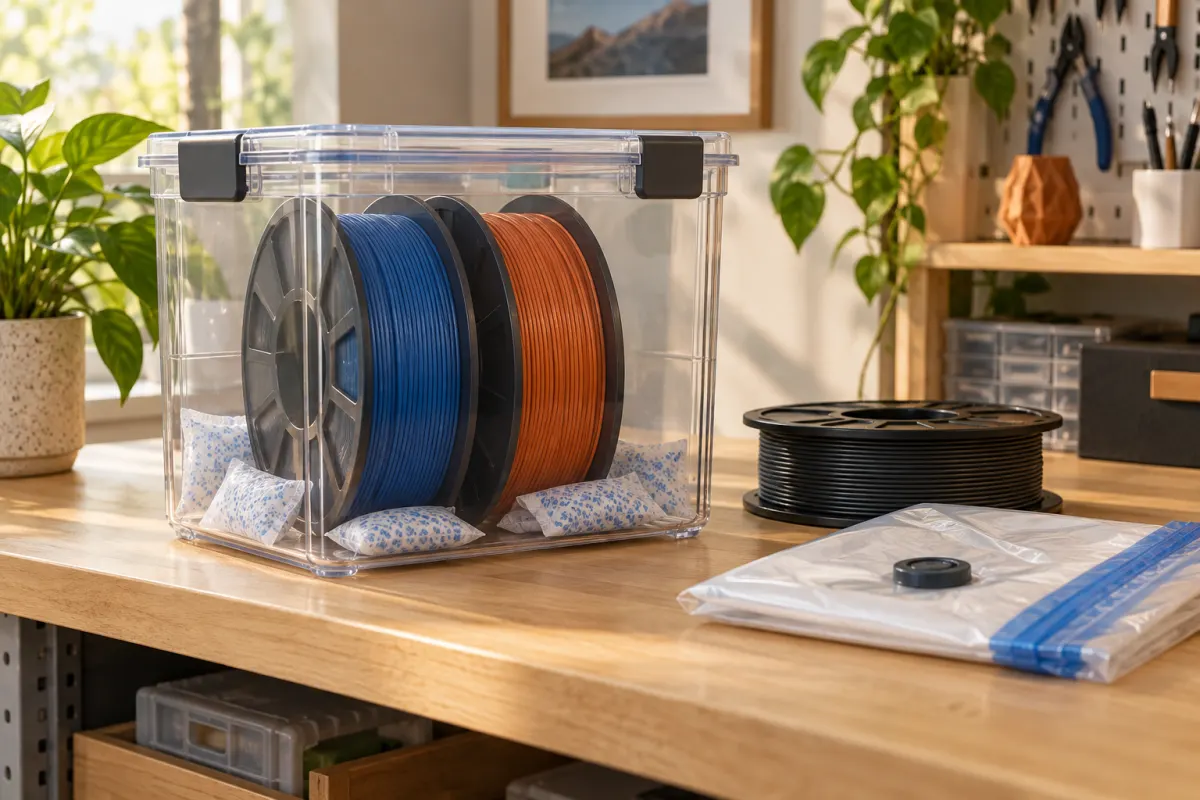
Compare storage products by their actual job
| Option | Checked price | Consider it for | Important limitation |
|---|---|---|---|
| PolyDryer Box, standard size | Box only: $29.99 | Individual spools in a modular storage and drying system | The box-only purchase has no powered drying dock |
| Prusa USS Drybox | Base listing: $32.40 | Dry feeding from a supported Prusa mounting arrangement | Verify printer model, required printed parts, and spool fit |
| PolyDryer Box XL | Box only: $69.99 | Larger reels within 300 mm diameter × 118 mm width | Powered drying requires a dock and the appropriate XL adapter |
| Resealable filament bags or gasketed storage containers | Compare your complete kit locally | Occasional colors that do not need enclosed feeding | Check closure, usable dimensions, and desiccant maintenance |
Price check: October 9, 2026. Listed US-dollar prices refer to the exact variants named, before tax and shipping. Promotions, colors, packages, and availability can change; confirm the final cart.
Bag and container designs vary too much to promise equivalent sealing from a product photo. The named products are candidates with documented functions, not winners from a comparative test.
Price the complete kit, including what is missing
A usable storage setup needs enough internal room for the loaded reel, a closure you can seal consistently, suitable desiccant, and an identifiable place for the spool label. A hygrometer or humidity indicator can help monitor the environment; it does not directly measure absorbed moisture inside the filament.
For a bag kit, count full-size bags rather than accessories. A listing with a pump, clips, and tiny sample bags can advertise many pieces without providing many usable spool spaces. Check whether replacement bags and desiccant are easy to obtain.
For a dry-feeding box, add the required tubing, fittings, holder, and mounting parts. Verify the supported path to the printer. Do not assume that a box with an outlet includes everything needed for your specific installation.
Treat the Prusa USS Drybox as a specific installation
Prusa describes USS Drybox as passive storage using desiccant, not an active dryer. Its documentation lists compatible printer arrangements and notes that third-party spools may require adapters, particularly cardboard reels. Prusament and Buddy3D spools are documented fits.
For an MK4 or MK4S, read the dedicated installation instructions. Prusa does not support that installation inside the Original Prusa Enclosure, and the same instructions do not establish compatibility with an MK3S or another printer. Check the required printed mounting pieces before the box arrives.
This is a good candidate when the supported mount and feeding route simplify your setup. Skip it as an automatic choice for a mixed-printer workshop until each intended arrangement has been checked. A familiar logo does not make a specific accessory universal.
Calculate modular storage as a system
On the checked Polymaker US listing, one complete standard PolyDryer with a US dock and box cost $79.99. Adding two $29.99 boxes produces a $139.97 three-box setup with one shared dock. It does not create three simultaneous powered drying positions.
Polymaker documents separate drying and storage functions. That arrangement can be useful when you rotate several colors through one drying station and keep the others enclosed. If you only need passive storage, compare the cost of boxes alone with a simpler container kit.
For XL, the checked box was $69.99 and its dock adapter $7.99. With a separately listed $59.99 US dock, those components total $137.97. Check current packages and supported assembly; the larger box does not automatically include the adapter or heater.
Use a mixed storage plan if it fits your habits
Imagine six spools: one frequently used PETG, one TPU used for long jobs, and four PLA colors opened only occasionally. You might investigate two suitable dry-feeding spaces and four simpler sealed storage spaces instead of buying six powered devices.
First verify that the chosen feeding boxes and material procedures support those active jobs. Then label each storage position and keep an easy place for the filament end. Returning a spool to its assigned location should be part of finishing the print, not a separate cleanup project.
For infrequently used material, inspect the closure and follow the desiccant maker's replacement or regeneration instructions. Do not transfer a heating procedure from loose silica gel to a packaged product whose container may have different limits. See dryer versus dry box when deciding whether the preparation equipment needs upgrading too.
Skip redundant hardware and outdated recommendations
Check whether a product is still the manufacturer's current line. Polymaker’s PolyBox Edition II page showed it unavailable during our check, and a manufacturer response states that the line has been phased out in favor of PolyDryer boxes. An older recommendation is not enough reason to build a new storage system around it.
Skip an expensive box if you only need to store a few occasional colors and a suitable simpler kit meets that need. Skip a vacuum-bag bundle if it lacks the bag size or replacement supplies you need. Skip a storage-only box when the immediate problem requires active drying.
We have not measured leak rates, desiccant lifetime, sensor accuracy, or feeding resistance for these products. Use their documented limits to build a shortlist, then inspect fit, closure, and routing when the kit arrives. Our SUNLU dryer comparison covers powered alternatives when drying capacity is the actual missing piece.
Sources & further reading
- Polymaker: PolyDryer US packages and prices
- Polymaker: PolyDryer documentation
- Polymaker: PolyDryer Box XL specifications and US pricing
- Prusa: USS Drybox compatibility and maintenance
- Prusa: USS Drybox product and price
- Prusa: USS Drybox installation on MK4 and MK3.9 series
- Polymaker: legacy PolyBox Edition II status
Manufacturer guidance can change. Check the instructions for your exact printer, build surface, and filament.