Choose rainbow filament for a color gradient that changes as material is consumed; choose dual-color or tri-color filament for a surface that shows different colors from different viewing directions. Neither gives you precise control over which modeled feature receives a particular color.
Research checked October 9, 2026. This is a buying framework based on manufacturer documentation, not a hands-on test. Example budgets are hypothetical US-dollar calculations, not current offers.
A single-extruder printer can produce these decorative effects from one strand. That makes them useful for experimenting with color, provided you buy the effect your model can actually display.
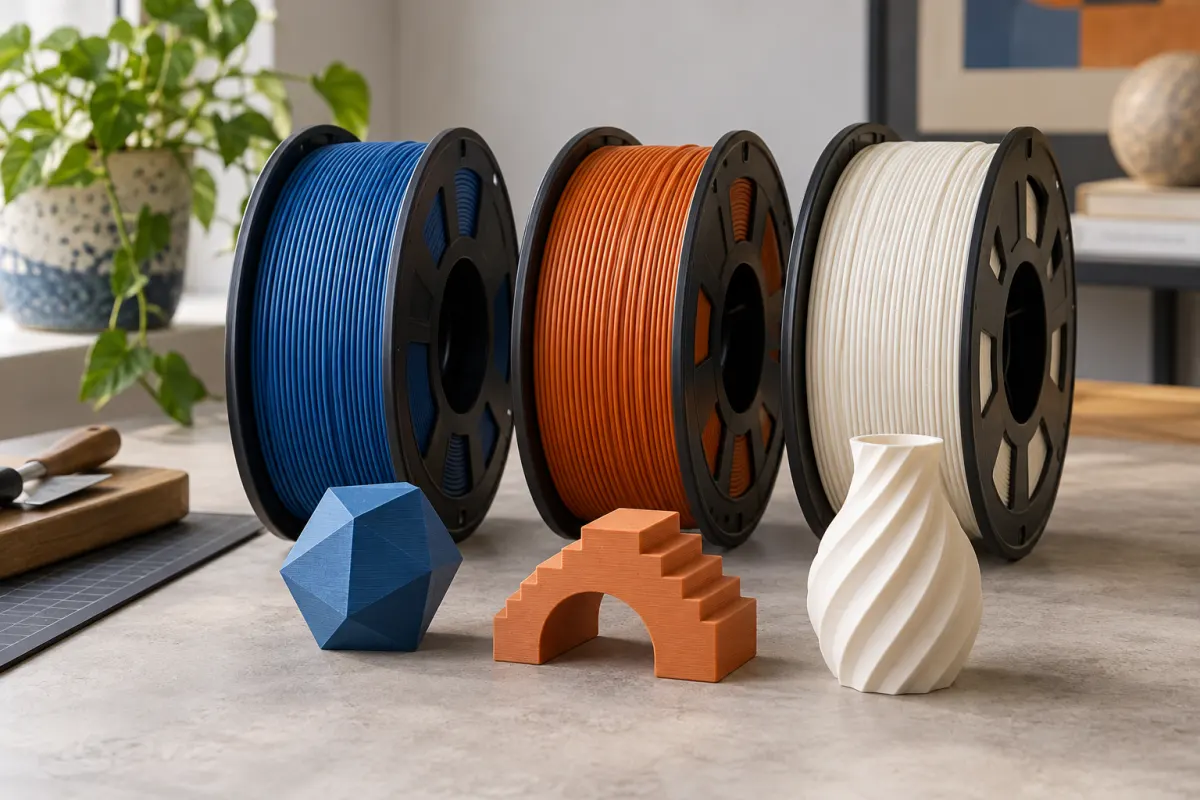
Choose the color behavior first
| Type | Expected visual behavior | Good first project | Main limitation |
|---|---|---|---|
| Rainbow or gradient | Color changes along the consumed filament | A larger display piece with enough material use | A small piece may show only part of the sequence |
| Dual-color | Two colors occupy the strand and can face different directions | A curved or faceted ornament | Orientation and extrusion path affect the visible split |
| Tri-color | Three colors provide additional viewing-angle variation | A decorative sculpture with several visible faces | It cannot assign each of three model features its own color |
| Plain-color silk | One color with a glossy surface effect | A shape whose highlights are the main attraction | Gloss is not a multicolor pattern |
SUNLU describes rainbow filament as a changing gradient; its multicolor silk listing describes colors changing with viewing angle. The practical choice follows that difference, not the number of colors shown on the spool photograph.
Rainbow transitions depend on how much you extrude
For a gradient, inspect the listing for a clearly defined transition or repeat length. A product name alone may not explain whether a number refers to one color change or a complete sequence. Ask if that distinction matters to the project.
A small hollow model may consume too little material to show the full range. A thicker object consumes more, so it may progress through colors differently at the same height. Supports and other objects on the plate also use sections of the strand; their consumption can move a later color into the main print.
That means two copies printed one after another need not start in the same color. Plan a deliberately varied collection when repeatable bands are not essential. For matching commercial sets or an exact logo, a controllable color process is usually a more suitable purchasing direction.
Use slicer length to set realistic expectations
Suppose a hypothetical spool description defines one full color sequence as 10 m. Your sliced ornament uses 2 m including supports. It consumes 20% of that stated sequence; there is no basis to expect all of the advertised colors in the ornament.
If five identical ornaments together use 10 m, the group consumes a sequence, but each piece will still receive only the portions assigned by the extrusion order. Printing them sequentially versus alternating between them by layer changes where that material goes. Preview the job and use a modest trial before committing to gifts.
Those lengths are an illustration, not SUNLU specifications. They show why “this is a rainbow spool” does not answer “will this 20 g object be rainbow?” Compare your slicer's consumption with the exact seller explanation, and allow extra material for a first trial.
For dual-color and tri-color, test orientation
These products are useful when the object will be turned in the hand or viewed from multiple directions. A rounded decorative shell may show the effect more clearly than a tiny letter on a flat top face. The filament's orientation through the feed path and the printed toolpath can influence which color becomes visible.
Print a small version or a representative curved section and mark its orientation on the bed. Examine the top, sides, and seam. If the appearance matters, repeat that setup with the actual roll rather than assuming a listing photograph predicts every face.
Dual-color does not mean two independently addressable extruders. You cannot tell the slicer to make the eyes blue and the body green using only the two halves of one decorative strand. See our multicolor printer-bundle guide when you need controlled color placement instead.
Match the finish and exact product variant
SUNLU’s rainbow listing offers named material and finish variants, while its separate multicolor silk listing offers dual-color and tri-color choices. Verify the selected material, color combination, shipping region, and net mass before ordering. A shared listing can contain options that produce substantially different effects.
Use the actual formulation's profile. Silk appearance, translucency, and ordinary PLA color are different purchase objectives; do not assume the same speed and temperature provide the finish you want. Our silk versus matte guide helps separate shine from color behavior.
SUNLU is one supplier of the verified products discussed here. The store link below opens the merchant rather than selecting a specific effect; choose the exact variant after checking the product description.
This link opens SUNLU’s store. Select the exact model, material, package, and shipping region described above.
We may earn a commission if you buy through links marked “paid link.” How our links work.
Browse the SUNLU store (paid link)Buy for the result, with a small material allowance
At hypothetical prices of $18 per kilogram for plain PLA and $26 for decorative filament, a 120 g ornament costs $2.16 versus $3.12 in material. The $0.96 premium may be attractive if it produces a finish you enjoy without painting. A failed 120 g trial, however, consumes another $3.12 before the successful piece.
- Decide whether you want lengthwise gradients or viewing-angle changes.
- Check how much material the actual model consumes.
- Confirm the exact finish, diameter, spool format, and feed-path fit.
- Reserve enough for a small appearance trial.
- Choose a controlled color process when precise placement or matching copies is essential.
We have not tested the color sequences, batch consistency, or finish of these rolls. Treat product pictures as illustrations of possible effects and your own sample as the basis for the final design. A little planned variation can be part of the appeal.
Sources & further reading
- SUNLU: PLA and silk rainbow filament
- SUNLU: dual-color, tri-color, and four-color silk filament
- SUNLU: how rainbow filament changes color
Manufacturer guidance can change. Check the instructions for your exact printer, build surface, and filament.