Choose silk PLA for a reflective decorative finish, matte PLA for a subdued finish, and standard PLA when you want a familiar baseline. These labels describe appearance more reliably than they predict toughness, heat resistance, or the best print settings.
Start with the look you want, then check the exact filament's profile and technical information. A small sample can answer questions a product photo cannot: how the finish looks in your room, where the seam lands, and whether the part's fine features print cleanly. This guide proposes a comparison method; it does not report hands-on tests.
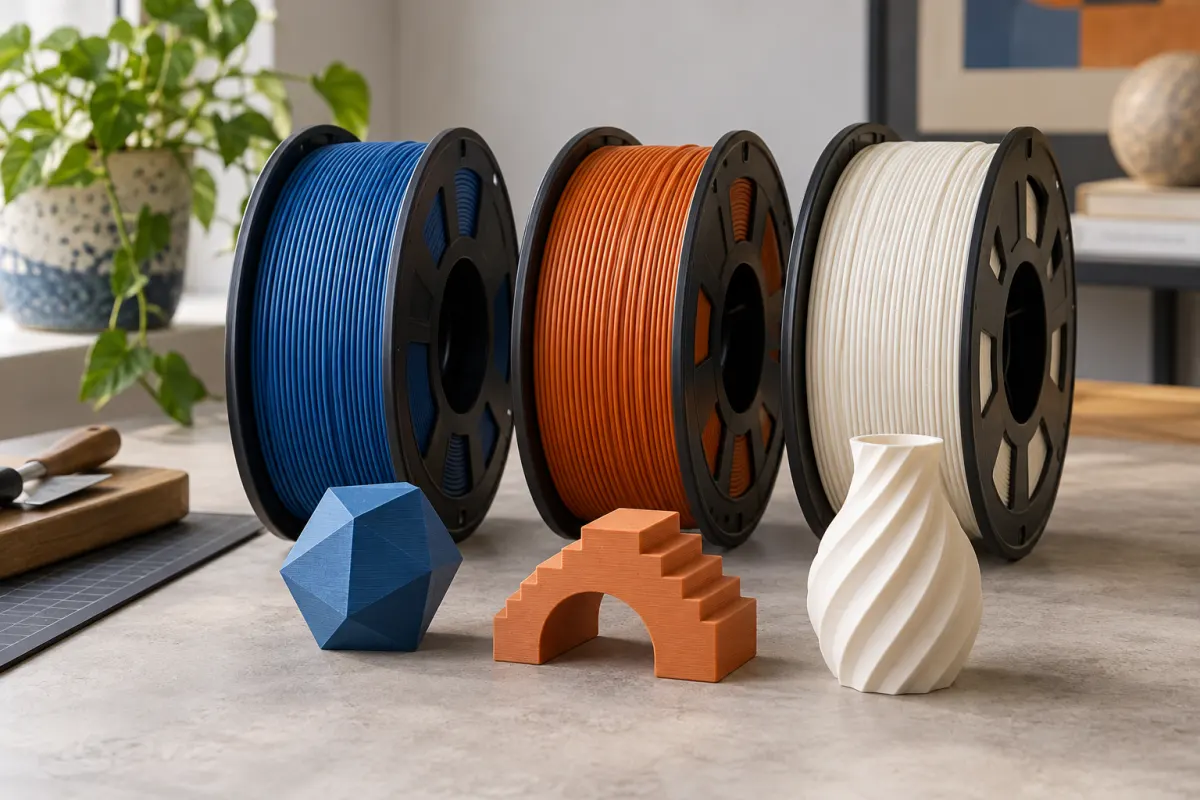
Choose around the object and its lighting
| Finish | Consider it for | Check on a sample |
|---|---|---|
| Standard PLA | Learning, prototypes, and familiar everyday prints | The actual gloss and color of that product |
| Silk PLA | Decorative curves, display objects, and reflective accents | Shine on side walls, top surfaces, and seams |
| Matte PLA | Muted décor, architectural forms, and display models | Fine lettering, surface texture, and the desired color |
Bambu Lab’s PLA Matte page describes a non-glossy finish that makes layer lines less visible. That is an appearance claim, not a claim that the printed geometry has no layers. A coarse layer height, visible seam, or damaged surface does not disappear simply because the filament is matte.
Product photos also depend on lighting and viewing angle. Compare sample prints where the finished object will actually sit, then turn them under the same light before choosing a large spool.
With silk, the print process is part of the finish
Polymaker’s printing tips recommend slower outer-shell printing for silk and other glossy options to preserve shine. Follow the guidance for the exact formulation rather than using one fixed speed for every silk spool.
Keep the manufacturer profile as your starting point. If the finish changes across the object, look at the sliced speed preview and identify whether the visible change lines up with a change in the toolpath. Test one relevant setting on a small model; changing temperature, cooling, and speed together makes the result hard to interpret.
Polymaker’s Panchroma Silk update describes changes to its silk formulation. That is another reason to keep product version and grade in your notes. An older recommendation for the same brand may describe a different material.
Keep the finish decision separate from strength
There is no need to declare every silk filament weak or every matte filament durable. Ask for data on the exact product and inspect how your part is loaded. A beautiful display model and a working latch have different success criteria.
For a latch, examine the bending feature, layer direction, and required movement. For a display model, the first priorities may be surface finish and support marks. Use our PLA and PLA+ comparison to read impact, stiffness, and thermal claims without confusing them.
Standard PLA also has limitations; Prusa’s PLA material guide explains its basic applications and heat limitations. A silk or matte label alone gives no basis for treating an object as heat resistant or suitable for a critical load.
Print a sample that answers your real questions
Use one modest model with a broad curved wall, a flat top, an obvious corner, and a little raised text. Alternatively, cut a representative section from your intended project. A flat color chip alone cannot show how shine follows a tall curved surface.
- Use the same printer, nozzle, orientation, and model for each sample.
- Use the appropriate profile for each exact filament. This compares practical results, not isolated polymer properties.
- Record the settings and photograph each sample from the same distance and angle.
- Inspect the side, top, underside, seam, and any support contact separately.
- Keep a labeled sample beside the spool so later projects do not rely on memory.
Choose a clear pass condition before printing: readable lettering, an acceptable seam on the hidden side, or a reflection you like from the usual viewing angle. “Looks better” becomes easier to decide when it refers to a specific feature.
Check the face that touches the plate
The underside takes its surface character from the build plate as well as the filament. If a visible face needs a particular finish, plan its orientation before printing. A silk side wall and a textured underside may be an intentional design choice, but they will not look identical.
Our build-plate comparison is specifically about genuine Prusa Smooth PEI, Textured, and Satin sheets with PLA and PETG on the MK4 or MK4S. For other machines, check the exact plate manufacturer's instructions. Similar surface names do not establish identical preparation or compatibility.
If the first layer fails, use the first-layer checklist. If an established profile suddenly develops a rough finish or strings, investigate possible moisture and other causes before assuming the finish formulation is at fault.
Buy enough to learn before buying in bulk
Check net filament weight, diameter, spool format, and the availability of a useful profile. A sample or single roll can establish whether you enjoy the appearance and workflow before you commit to a multi-spool package.
For decorative pieces, include the time you spend removing supports or placing seams. A cheaper material is not necessarily cheaper for a particular result if it needs more rejected attempts. Conversely, a premium finish adds little value to a hidden prototype where ordinary PLA already does the job.
Use your sample notes to make a simple choice: the finish meets the visual goal, the profile produces the details you need, and the exact material suits the intended use. That is more informative than treating silk, matte, and standard PLA as a single best-to-worst ladder.
Sources & further reading
- Bambu Lab: PLA Matte characteristics
- Polymaker: material printing tips
- Polymaker: Panchroma Silk PLA formulation update
- Prusa: PLA material guide
Manufacturer guidance can change. Check the instructions for your exact printer, build surface, and filament.